Nudge
A privacy-first social app where your keys never leave your device — PGP-encrypted chat and groups, a ranked feed, shareable profiles, and an opt-in location map. Running live in production.
What it is
Nudge is a privacy-first social app built around one rule: your keys stay on your device. It's a Rust workspace — a shared core library, an Axum server, and a Tauri v2 desktop client — with a TypeScript UI compiled to static assets and embedded in the server binary, so one container serves both the API and the web app.
The server stores only opaque ciphertext and routing metadata. Message bodies and attachments are PGP-encrypted on the client before they are sent, so the server never sees plaintext or private keys. There are three documented exceptions — public posts, the profile page, and location — each called out in docs/PRIVACY.md.
Nudge is deployed on Railway and running now — /healthz and /readyz both return 200. The v2 social workstreams (W1–W9) and the v3 app shell are shipped; the v4 maps and location-sharing release is the current head of the repo. The next two workstreams — messaging depth and rich profiles — are planned but not started.
What's shipped
Nine workstreams landed on top of the original shell. Each one is backed by a migration and covered by the integration suite, which runs 27 scenarios end to end against a real Postgres instance.
- Encrypted messaging — 1:1 and group chats, PGP end-to-end encrypted, delivered in real time over a WebSocket at
/api/v1/ws. Group chats carry owner / admin / member roles and a leave action. - Public feed and hashtags — a transient WYD status feed plus a public feed with hashtags and trending tags.
- Ranked home feed — three tiers: friends, then subscribed topics, then a popular fallback. Seen posts are de-prioritised rather than hidden; reactions, mutes, and topic subscriptions shape the ranking.
- Shareable profile pages — a full-screen page at
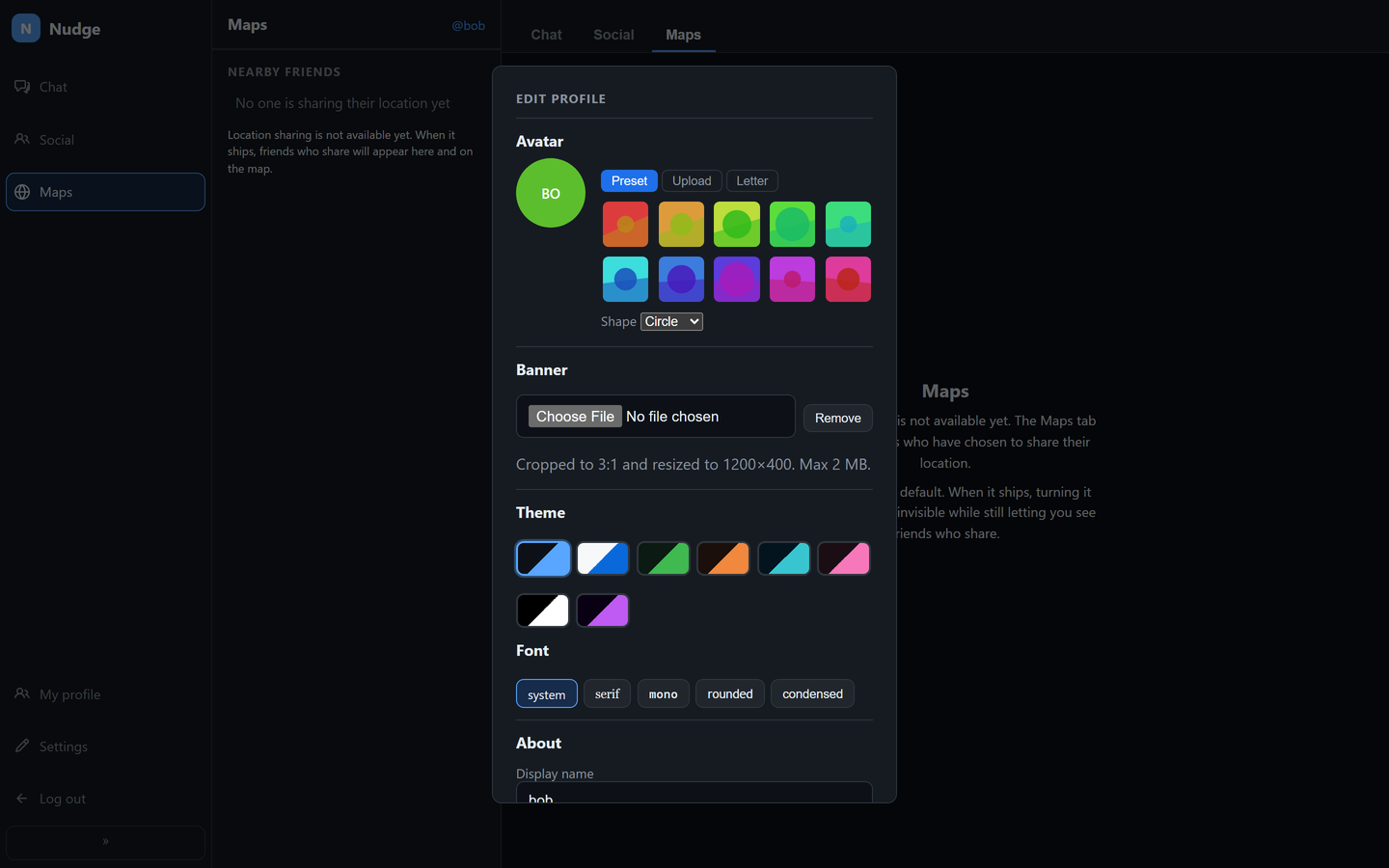
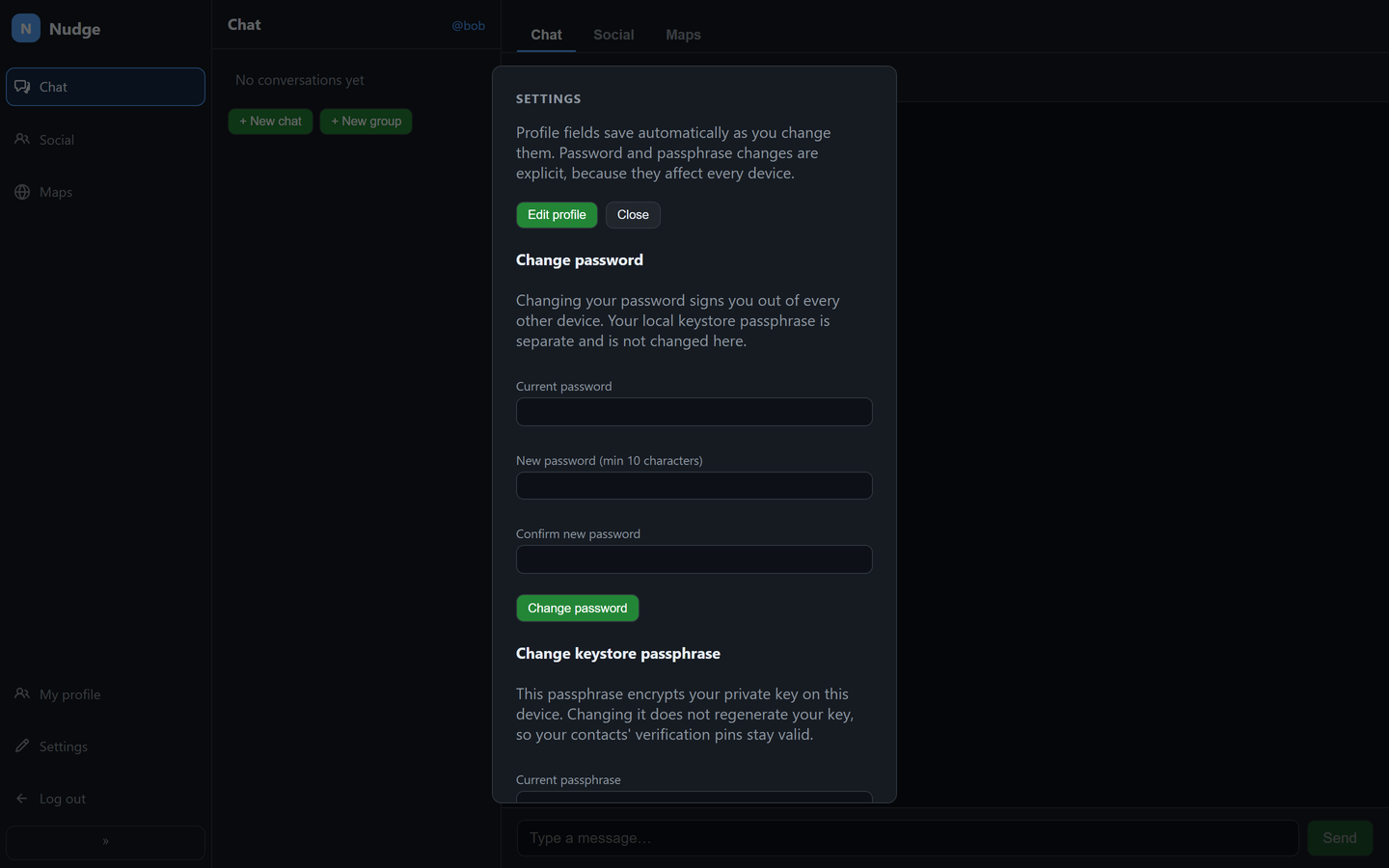
/u/{username}with a copy-link button, 8 themes and 5 fonts stored server-side, a 3:1 banner, a six-image gallery, and wall posts with per-post friends-only or public visibility. - Auto-saving settings — profile fields save as you change them with an inline confirmation. Password and keystore passphrase changes stay explicit submits, because they affect every device.
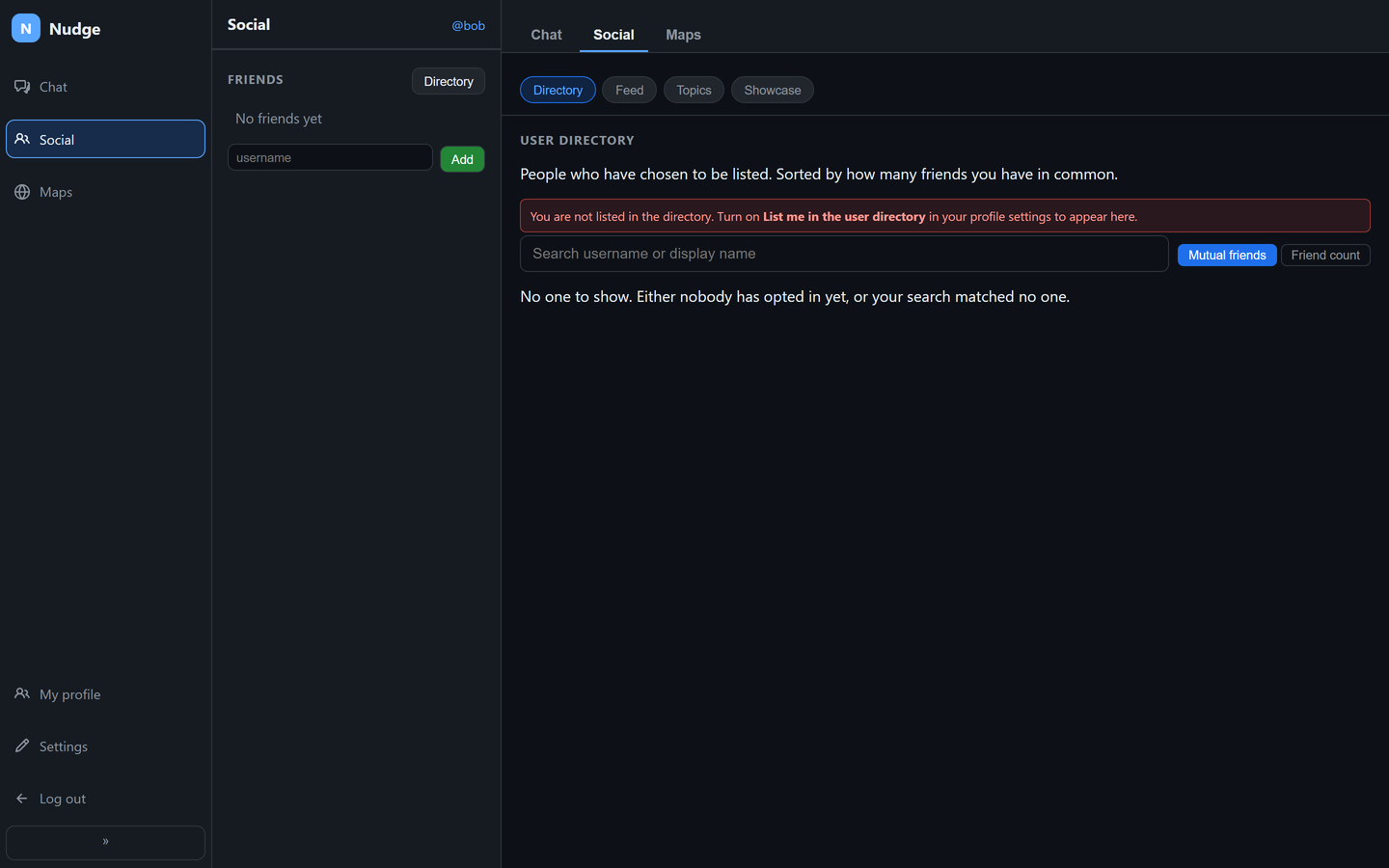
- Opt-in user directory — a browsable "yellow pages" of users who chose to be listed, sortable by mutual friends or total friend count, with friend request, block, and report actions inline.
- Maps and location sharing — a Maps tab showing accepted friends who opted in, on Leaflet (~44 KB gzipped, lazy-loaded). Marker semantics match precision:
cityrenders as a ~25 km circle, never a pin. - Account and safety — proof-of-work registration gating, Postgres-backed rate limiting shared across instances, moderation with reports and suspension, account export and deletion with a 7-day grace period, and a warrant canary endpoint.
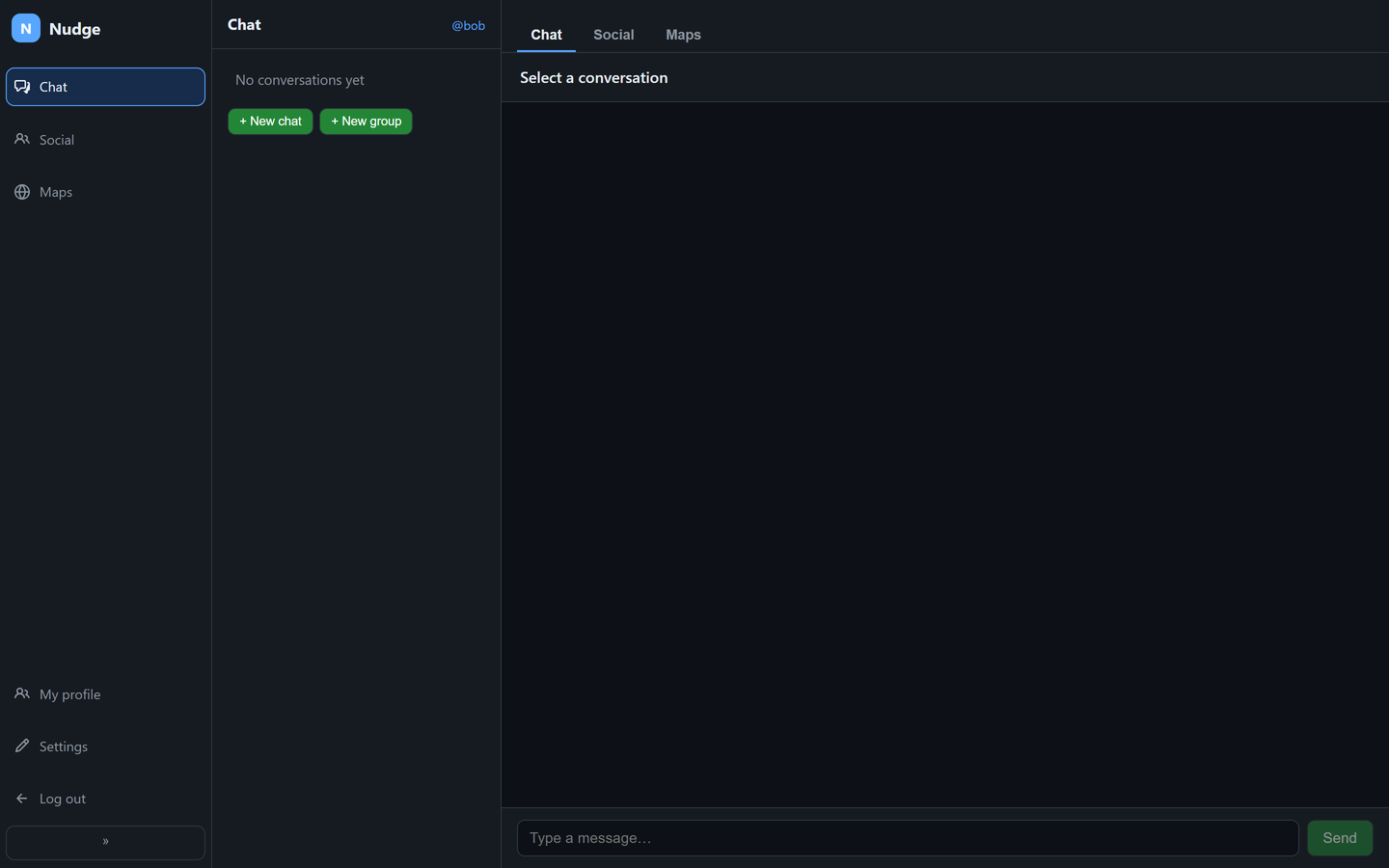
The v3 app shell is also in: a three-zone layout with a 64px navigation rail that expands to 220px on wide screens, a 300px list pane, a content pane, and a contextual rail at 1280px and above that collapses to a slide-over below that. Breakpoints at 1440, 1280, 900, and 480px, with a bottom tab bar under 480px.
The interface
Three surfaces, one navigation: Chat for conversations and groups, Social for friends, the directory, feed, and topics, and Maps for location sharing — off by default, always opt-in.
How the security works
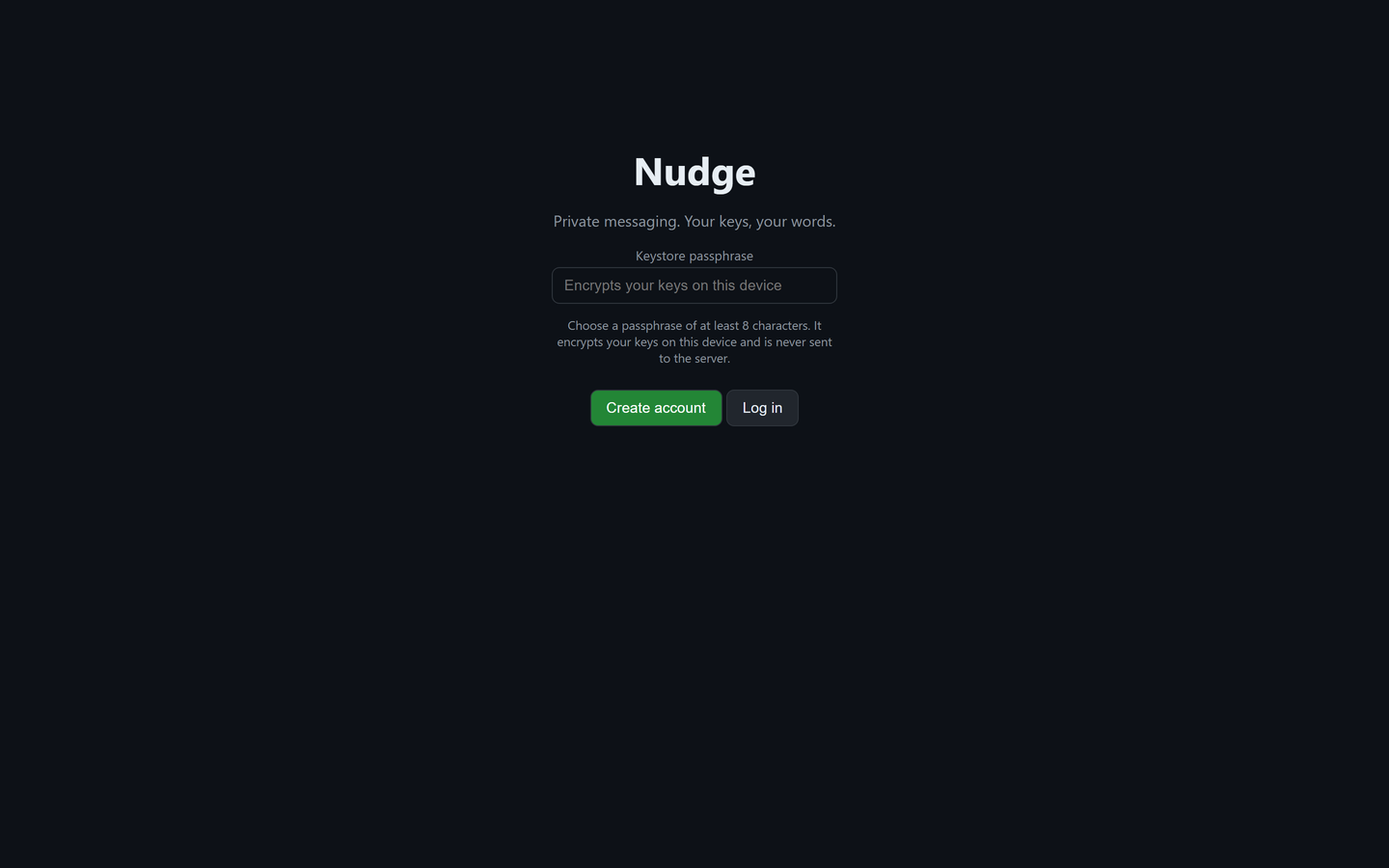
Two secrets, kept apart on purpose. Your keystore passphrase encrypts your private key locally — it's Argon2-derived, AES-GCM sealed, and zeroized from memory when done. It never leaves the device. Your account password is a separate server-side credential; changing one doesn't touch the other.
- Local keystore — keys generated on-device, encrypted at rest, unlocked by a passphrase the server never sees. The passphrase can be changed without regenerating the keypair, so fingerprints and every contact's verification pin stay valid.
- PGP-capable messages — the crypto core is built on the
pgpcrate, with message encryption handled in the client. Direct-chat messages are stored as two armored parts, one per participant, so each side decrypts its own copy without sharing a key. - Hardened password storage — the server does its own Argon2id hashing; the client pre-flight hash is never transmitted.
- Zeroize on drop — sensitive material is wiped from memory rather than left to the garbage collector.
- Consent-gated location —
cityprecision is fuzzed server-side to a ~25 km grid, deterministically per user per day. The client never receives the raw coordinate back, positions expire on the owner's TTL, and turning sharing off deletes the stored position immediately. - Proxied map tiles — tiles are fetched through the Nudge server and cached to disk, so the browser never contacts a third-party tile host. The upstream sees the server's IP, not yours.
Where it stands
The social product is real and running: authentication, the keystore flow, encrypted 1:1 and group messaging, the ranked feed, shareable profiles, the user directory, and the location map all work end to end against a live Postgres database. The integration suite covers 27 scenarios, including precision-fuzzing determinism and TTL expiry with block enforcement.
-
Shipped
Core shell and security
Keystore unlock, proof-of-work registration, account auth, password change, and the separate keystore passphrase — all running against the Axum server.
-
Shipped
Social layer (W1–W9)
Public feed and hashtags, profile enrichment, group chats with PGP, ranked feed with seen tracking, hidden server URL, shareable profile pages with auto-saving settings, and the opt-in user directory.
-
Shipped
App shell and maps (v3 / v4)
The three-zone navigation redesign — nav rail, list pane, context rail — plus the Maps tab and consent-driven location sharing with server-side precision fuzzing and proxied tiles.
-
Next
Messaging depth (V2)
Read receipts and unread counts, message edit and soft delete, typing indicators, in-conversation search, encrypted attachments, and a conversation details rail. Migration 0014.
-
Next
Rich profiles (V3)
Profile announcements with a formatting toolbar, gallery titles and drag-reorder, pinned wall posts, and banner focal-point plus accent controls. Migration 0015.
Read receipts and message edits are schema-ready but have no write path or UI yet — they land with V2. Rich profile content (announcements, formatting, gallery detail, pinned posts) lands with V3. There is no geocoding or address search in v4.